Follow Us

Tag: Newsletter 2nd Article

  • Bosch opens first franchise in Oklahoma, 14 more to come

    Bosch opens first franchise in Oklahoma, 14 more to come

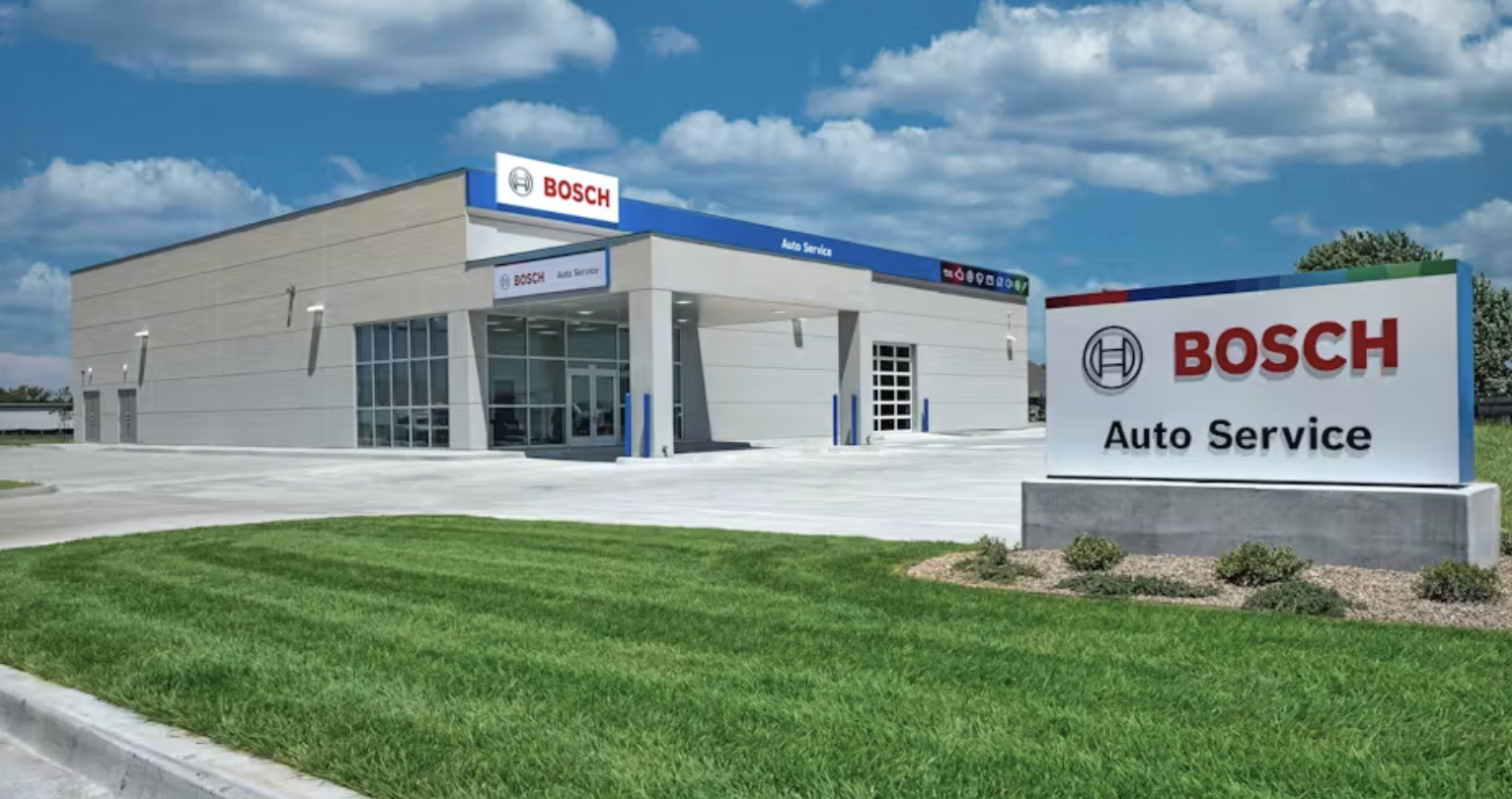
    Bosch Automotive Workshop Services LLC recently opened its first ground-up franchise location in Oklahoma City.

    The new location represents the first of 15 planned Bosch Auto Service locations across Oklahoma, led by longtime local Battison Honda dealership owner and entrepreneur Larry Battison.

    The 10,000-square-foot facility was purpose-built and features a 7,000-square-foot technician workspace equipped with advanced diagnostic and calibration technology, including a Bosch ADAS calibration machine.

    The shop also features Bosch Home Comfort, Bosch Power Tools and Bosch Dealer Equipment Services, Bosch Diagnostics, OTC and Robinair solutions, tools and equipment.

    Bosch Auto Service locations are supported by Bosch training, diagnostic technology and operational resources while allowing owners to maintain local leadership and community ties.

    A June 13 grand-opening community event will also highlight workforce development and technical education through the Battison Foundation.

    The foundation will award $60,000 in scholarships, including six $10,000 scholarships to students attending Oklahoma City Community College, Metro Technology Centers, Francis Tuttle Technology Center, Tulsa Community College, Tulsa Tech and Norman Moore Technology Center. 

  • M&K Truck Centers acquires 5-location group in Minnesota and Iowa

    M&K Truck Centers acquires 5-location group in Minnesota and Iowa

    M&K Truck Centers recently announced the acquisition of five GATR Truck Center dealerships—three located in Iowa and two in Minnesota.

    This acquisition, finalized on May 29, involves substantially all of the assets of five GATR Truck Center locations serving Iowa and Minnesota.

    Terms of the transaction were not disclosed.

    Effective immediately, M&K will expand its product offerings across Iowa and Minnesota.

    • Cedar Rapids, Iowa: Volvo, Mack, and Hino
    • Waukee, Iowa: Volvo and Hino
    • Waterloo, Iowa: Volvo and Mack
    • Elk River, Minnesota: Volvo
    • Sauk Rapids, Minnesota: Volvo and Hino

    Full support services and parts will be available at all locations.

    With this acquisition, M&K expands its footprint to 38 locations across nine states, marking a significant milestone for the company.

    M&K Truck Centers has retained nearly all employees from GATR Truck Center, welcoming over 200 talented people into the M&K family.

    “We look forward to an exciting future as we work together to integrate these operations. By incorporating the operations from these five locations, our company will enhance its offerings in new and used truck sales, trailer sales, parts, service, rentals, and leasing. “This expansion allows us to increase our capabilities and strengthen our presence in the central region. We remain committed to meeting our customers’ needs and providing exceptional service throughout this transition and for many years to come,” stated Josh Wolf, M&K’s COO.

    M&K Truck Centers is the largest Mack and Volvo dealer group in North America and the first to earn Volvo Trucks’ 1K, 2K, and 3K sales volume awards. In 2025, M&K achieved the landmark 3K sales volume award, so­­lidifying its position as the first and only dealership to reach this historic milestone.

  • Fleet maintenance provider Amerit acquires Canadian reefer repair specialist company

    Fleet maintenance provider Amerit acquires Canadian reefer repair specialist company

    Amerit Fleet Solutions, a leading provider of fleet maintenance and fleet solutions based in Walnut Creek, California, today announced the acquisition of Pro Reefer, a Canada-based fleet maintenance provider specializing in refrigerated trailer units.

    Terms of the deal were not made public.

    This acquisition strengthens Amerit’s refrigerated fleet service offerings and expands Amerit’s footprint into Canada, enhancing support for customers across the U.S. and Canadian markets, according to a statement from Amerit.

    Founded in 1998 with a dedicated focus on reefer systems, Pro Reefer has built a strong reputation for high-quality maintenance, diagnostics, and repair services for refrigerated trailers and transport refrigeration units. For over 28 years, the company has served customers in food distribution, cold chain logistics, and temperature-sensitive freight, providing preventive maintenance, emergency repairs, and compliance-driven service solutions.

    “Pro Reefer’s deep technical expertise in refrigerated equipment, excellent and tenured leadership team, and strong entrepreneurial culture make the company a fantastic fit for Amerit,” said Ross Rachey, Chief Executive Officer of Amerit Fleet Solutions. “This acquisition allows us to further support customers while expanding our service capabilities and geographic reach in Canada.”

    “We are excited to join Amerit and become part of an organization that shares our commitment to reliability, safety, and service excellence,” said Thomas Vandermeer, President and Founder of Pro Reefer. “I am honored to lead this organization into our next chapter, which will enable us to deliver even greater value to our customers while continuing to specialize in the reefer services they depend on.”

    “Pro Reefer is a perfect example of a market-leading management team and employee base that Amerit aims to partner with,” added Adam Lev, VP of Corporate Development. “We are excited to continue our growth story in the Canadian market.”

    The acquisition reflects Amerit’s continued investment in fleet solutions and its long-term strategy to support complex fleet operations across multiple asset types and geographies..

    Amerit Fleet Solutions is a provider of customized fleet maintenance and fleet solutions. Amerit manages over 350,000 assets and employs over 3,000 technicians. Amerit’s core services include mobile and onsite fleet maintenance, acquisitions and disposals, compliance, fueling, ops support center and Claims, and Program Management. Through these comprehensive services, Amerit helps organizations improve vehicle uptime, safety, and operational efficiency, according to the company.

  • 574 vehicles placed out of service in one-day North American brake inspection blitz

    574 vehicles placed out of service in one-day North American brake inspection blitz

    Certified commercial motor vehicle inspectors throughout North America conducted 4,021 inspections of commercial motor vehicles during a recent surprise one day enforcement blitz, and placed 574 of those vehicles out of service due to brake-related violations.

    Brake Safety Day is the Commercial Vehicle Safety Alliance’s (CVSA) annual brake-safety inspection, regulatory compliance and data-collection initiative. Forty-seven jurisdictions throughout Canada, Mexico and the U.S. participated in this year’s Brake Safety Day, which was April 14.

    This year, emphasis was placed on drums and rotors. Inspectors identified 43 drum and rotor violations, of which 21 were out-of-service violations, according to the CVSA.

    Inspectors identified 313 commercial motor vehicles that met the 20% defective brakes out of-service criterion, which is when 20% or more of the vehicle’s (or combination of vehicles’) brakes have a condition that impairs braking ability to a degree that the brake is considered defective.

    In addition, inspectors identified 121 out-of-service violations related to brake hoses and/or tubing, 47 vehicles had steering axle out-of-service violations, 40 vehicles failed an air loss rate test, and there were 193 other out-of-service brake violations, such as inoperative tractor protection system, hydraulic or electric brake violations, inoperative parking/emergency brake, inoperative low-air warning device, etc. 

    Ten U.S. jurisdictions conducted 349 inspections utilizing a performance-based brake tester (PBBT), which is a machine that assesses the braking performance of a vehicle. U.S. Federal Motor Carrier Safety Regulations and CVSA’s North American Standard Out-of-Service Criteria require a minimum braking efficiency of 43.5%. Twenty-six vehicles failed to meet the required 43.5% minimum braking efficiency rate and were placed out of service.

    Most of the inspections completed (3,643 or 90.6%) on Brake Safety Day were North American Standard Level I Inspections. A Level I Inspection is a thorough 37-step procedure that examines the driver’s operating requirements and assesses the vehicle’s mechanical fitness. The Level I Inspection is the most-commonly conducted inspection type overall.

    CVSA’s Brake Safety Day is part of Operation Airbrake, a CVSA program dedicated to improving commercial motor vehicle brake safety throughout North America. CVSA’s seven-day brake safety campaign is scheduled for Aug. 23-29.

  • JD Power Study: Aftermarket providers seen as less expert than dealers

    JD Power Study: Aftermarket providers seen as less expert than dealers

     Cost and affordability are playing an increasingly important role in the aftermarket service experience, according to the JD Power 2026 U.S. Aftermarket Service Index (ASI) Study, released recently, as customers hold onto their vehicles longer and maintenance needs shift toward more complex repairs.

    Year-over-year changes in customer satisfaction across the three segments examined in the index are mixed, with improvement in quick oil change (+4 points on a 1,000-point scale) but declines in tire replacement (-3) and full-service maintenance and repair (-7).

    Index results show that aftermarket providers are perceived as more convenient than dealers, particularly in speed of service. Even among same-day dealer visits, fewer than one in five (17%) dealer service customers have work completed within an hour, compared with 52% of tire replacement customers and 49% of full-service maintenance and repair customers at aftermarket providers.

    This speed advantage reinforces why customers continue to choose aftermarket providers primarily for convenience and prior positive experiences. At the same time, a growing share of customers also cite lower costs as a factor, pointing to rising price sensitivity and underscoring the need for aftermarket providers to continue emphasizing both speed and value. 

    “Affordability is playing an increasingly important role in the aftermarket service experience, but delivering on the fundamentals remains critical,” said Lisa Nguyen, manager of OEM Solutions at JD Power. “Index data shows that aftermarket providers are largely executing where it matters most, with the majority of impactful key performance indicators (KPIs) completed more than 70% of the time and the top two — the service advisor being completely focused on customer needs and providing helpful guidance — exceeding 90% completion rates across segments. At the same time, there are clear opportunities to improve. Areas like facility cleanliness and comfort continue to lag, and more consistent customer engagement through immediate greetings and post-service follow-up can further elevate the experience and differentiate providers.”

    Some key findings of the 2026 index include: 

    • Aftermarket providers still combat a perception of less expertise than dealer service: Despite consistently strong performance in fixing issues correctly the first time, with segment averages above 95% over the past five years and annual outperformance versus dealer service on this metric, aftermarket providers still face a clear perception gap. Customers continue to trust them less than dealers, particularly in their perceived ability to maintain peak vehicle performance and handle complex repairs. In the full-service maintenance and repair segment, trust scores in these areas average 6.07 and 5.89 (on a 7-point scale), compared with 6.31 and 6.20 among dealer customers.
    • Advisor communication and responsiveness can make or break satisfaction: Two service advisor measures were added to the ASI this year, with aftermarket providers performing well on both: the advisor being completely focused on customer needs (the most impactful index KPI) and clearly communicating when the vehicle will be ready before service begins. For example, among tire replacement customers, satisfaction is 861 when customers feel the advisor is fully focused on their needs but drops sharply to 566 when they believe this is not the case. Aftermarket providers also slightly outperform dealers in setting service timelines up front, with dealers achieving this just 80% of the time3.
    • Usage of and preference for text message communication continues to rise: Across all three segments, more customers report communicating with their service advisor via text message compared with last year, with texting now more common than phone calls in the tire and oil change segments. More than half of customers across all segments now prefer texts for service updates, and aligning with that preference meaningfully impacts satisfaction. Among customers who prefer texts and receive them, satisfaction is 854 but dips to 840 when they receive a phone call instead. Text messaging also enables advisors to share photo and video multi-point inspection results, more than doubling the likelihood that customers will approve recommended work, yet the industry shows no meaningful improvement in providing this documentation.

    Index Rankings 

    Goodyear Auto Service ranks highest in the full-service maintenance and repair segment with a score of 846. Tuffy Tire and Auto Service Centers (843) ranks second and Christian Brothers Automotive (834) ranks third. 

    Express Oil Change and Tire Engineers ranks highest in the quick oil change segment for a fourth consecutive year, with a score of 854. Take 5 (833) ranks second and Jiffy Lube and Valvoline Instant Oil Change (823) rank third, in a tie.

    Meineke Car Care Centers ranks highest in the tire replacement segment with a score of 856. Pep Boys (850) ranks second and Discount Tire (847) ranks third. 

    The U.S. Aftermarket Service Index (ASI) Study, now in its seventh year, measures customer satisfaction with aftermarket service facilities, providing a numerical index ranking of the highest-performing facilities in the U.S. aftermarket. Performance in three segments—full-service maintenance and repair; quick oil change; and tire replacement—is based on the combined scores for seven factors that comprise the vehicle owner service experience. These factors are (in alphabetical order): ease of scheduling/getting vehicle in for service; fairness of charges; service advisor courtesy; service advisor performance; service facility; time to complete service; and quality of work. Franchise dealers and aftermarket service providers can use ASI to identify where to close gaps to capture more service customers and increase their revenue share in a growing market of aging vehicles and higher service spending.

    The 2026 study is based on responses from 10,572 vehicle owners.

    For more information about the U.S. Aftermarket Service Index (ASI) Study, visit https://www.jdpower.com/business/automotive/us-aftermarket-service-index-asi-study.

  • Volvo’s new D13 engine designed to meet 2027 emissions standards

    Volvo’s new D13 engine designed to meet 2027 emissions standards

    Volvo Trucks North America has introduced a new engine designed to meet the 2027 emissions standards set by the U.S. Environmental Protection Agency while continuing to deliver the performance, efficiency, and reliability fleets depend on. The new engine reduces nitrogen oxide (NOx) emissions by over 80 percent compared with current standards, delivering the power to support cleaner operations without compromising capability, according to a statement from the company.

    TIn a statement, Volvo said the new D13 engine takes all the best learning from Volvo’s previous D13 platform, Volvo’s most produced engine in the world, with aftertreatment technology that has been refined over more than a decade in commercial use. It meets emissions requirements in all 50 states, giving fleets the flexibility to operate across every U.S. market without modification whether they are running highway routes, regional haul, or vocational operations.

    “This engine is our most powerful, fuel-efficient engine ever and delivers on every front for our customers: lower emissions, strong performance and compatibility with the fuels and systems fleets already use,” said Peter Voorhoeve, president, Volvo Trucks North America. “The 2027 standards build on technology the industry knows well, and we have aligned our production, supply chain and dealer network so customers have what they need from day one.”

    More power where it counts
    Volvo’s new engine offers expanded horsepower and torque options, with ratings up to 540 horsepower and 1,950 lb.-ft. of torque, giving customers added flexibility to spec the right engine for demanding applications.

    Engine braking performance has also been enhanced, delivering up to 630 braking horsepower to provide stronger downhill control and improved drivability for heavy loads and steep grades.

    Built for fuel efficiency across the job
    Fuel efficiency is a key focus of the new platform. The engine is designed to support improved fuel economy for regional haul and vocational customers, while continuing to deliver strong efficiency for long‑haul highway operations. System refinements are aimed at lowering total fuel consumption without adding complexity to daily operations.

    The engine is compatible with renewable diesel (R100) and biodiesel blends up to B20, giving fleets added flexibility as alternative fuel options become more widely available.

    Cleaner engine, same durability
    The EPA’s 2027 regulations target further reductions in NOx and particulate matter to improve air quality and public health. Volvo’s new engine is designed to meet the EPA’s 35‑milligram NOx standard and comply with emissions requirements in all 50 states.

    Rather than introducing an entirely new system, Volvo’s approach builds on aftertreatment technology that has been in commercial use for more than a decade, supporting durability, serviceability, and uptime. The next generation engine follows Volvo’s current D13 engine that is already one of the most efficient powertrains in the truck industry. The all-new in-house developed engine will save even more fuel in a wider range of user applications and segments.

    What fleets can expect
    The new engine will be available across all Volvo truck models and has been developed in parallel with Volvo’s production operations, dealer network, and service infrastructure to support the transition when the EPA 2027 standards take effect on Jan. 1, 2027. Volvo said it continues to align training, parts availability, and service readiness to support customer adoption and long‑term operation.

  • Charlotte Auto Dealers hold annual Auto Tech competition

    Charlotte Auto Dealers hold annual Auto Tech competition

    The Greater Charlotte Auto Dealers Association (GCADA) recently hosted its 4th Annual Auto Tech Competition at Charlotte Motor Speedway, bringing together high school students and local dealerships to strengthen the automotive technician pipeline and connect future talent with career opportunities.

    Presented by the Carolina Ford Dealers, the competition allowed students to demonstrate their skills through hands-on, on-vehicle challenges after weeks of preparation with dealership mentors. Throughout the day, dealers engaged with students during interviews, a career fair, and a Dealer & Student Q&A, highlighting the critical role dealerships play in developing tomorrow’s technicians.

    The event concluded with a Winner Circle ceremony, awarding more than $30,000 in college scholarships to the top teams:

    • 1st Place: Career Academy & Technical School Team 4 – Randy Marion Subaru
    • 2nd Place: Hickory High School – Mike Johnson’s Hickory Toyota
    • 3rd Place: Forest Hills High School Team 1 – Honda of Indian Trail

    “This competition connects students directly with dealers and reinforces the importance of growing our technician workforce,” said GCADA Executive Director Ahmad Halawi.

  • Ryder opens  new truck rental and maintenance facility in Alabama

    Ryder opens new truck rental and maintenance facility in Alabama

    Ryder System, Inc. is expanding its Southeast presence with the opening of a new 10,000-square‑foot full-service commercial truck rental and maintenance facility in Huntsville, Alabama. Located near Exit 7 off I-565 and seven miles from I-65, the facility provides access to fleet, rental, and maintenance services in one of Alabama’s fastest-growing industrial and logistics markets.

    Positioned near major automotive manufacturers, food distributors, and government operations, the Huntsville location strengthens Ryder’s port-to-door logistics service model and supports customers across North Alabama’s expanding supply chain ecosystem. The site features four full drive-through maintenance bays, one half bay, and 24/7 self-service fuel island. RyderGyde technology and a self-service check-in kiosk provide real-time fleet visibility, diagnostics, and shop status updates.

    “This expansion underscores Ryder’s commitment to supporting customers in high-growth manufacturing and logistics markets,” says Tom Havens, president of Fleet Management Solutions at Ryder. “Huntsville’s strong infrastructure and accelerating activity across automotive, aerospace, and government operations make it a natural fit for expanding our service footprint. Tech-enabled solutions at this site ensure customers have the speed, visibility, and reliability they expect.”

    The Huntsville location includes a rental counter, driver lounge, and 160 parking spaces with available trailer parking. LED lighting, upgraded ventilation, and modern safety upgrades support efficient shop operations. Services include commercial truck rental, full-service leasing, fueling, and on-site and mobile maintenance services to support customers.

    As demand grows, the Huntsville facility is expected to create new opportunities for skilled technicians, rental agents, and customer service professionals. Open positions are available at ryder.com/careers

  • McKee  Foods tech cleans up at TTA competition

    McKee Foods tech cleans up at TTA competition

    The Tennessee Trucking Association held its annual Technician Skills Competition recently, and announced the winners.

    The overall competion’s top finishers included:

    • 1st Place – Kyle Kiser, McKee Foods
    • 2nd Place – Brad Calfee, Walmart
    • 3rd Place – Glenn Booth, Rush Truck Centers

    Station winners were:

    • Recommended Practices – Brad Calfee, Walmart
    • Remote Diagnostics – Kyle Kiser, McKee Foods
    • Service Information – Kyle Kiser, McKee Foods
    • Electrical – Kyle Kiser, McKee Foods
    • Tire Monitoring Systems – Homer Knight, McKee Foods
    • Engines – Ryan Makurat, Old Dominion Freight Line
    • Brakes – Matthew Booker, Dobbs Peterbilt
    • Fasteners – Glenn Booth, Rush Truck Centers
    • Wheel End – Brad Calfee, Walmart
    • Written Test – Brad Calfee, Walmart
  • 67 earn World Class Technician status

    67 earn World Class Technician status

    The Auto Care Association and the National Institute for Automotive Service  Excellence recently announced the newest automotive professionals to earn the prestigious World Class Technician designation in 2026.  

    The ASE World Class Technician designation recognizes automotive service professionals who have demonstrated an exceptional level of technical expertise and commitment to ongoing training and certification. To earn the designation, technicians must pass a rigorous series of ASE certification tests across multiple specialty areas. 

    This year’s newly recognized ASE World Class Technicians represent a wide range of experience across the automotive service industry, including independent repair facilities, fleet operations, education, dealerships and emerging electric vehicle service roles.

    The following technicians earned the ASE World Class Technician designation in 2026: 

    • Jesse Ackerman — Strawberry Plains, Tenn. 
    • Edward Dan P. Aclaro — Tamuning, Guam 
    • Jonathan M. Adams — St. Helena Is., S.C. 
    • Nicholas C. Anselmo — Grapevine, Texas 
    • Ben Avesani — Cape Coral, Fla. 
    • Chris M. Bachura — Council Grove, Kan. 
    • Clifton G. Barse — Farmington, Mo. 
    • Robin P. Bruce — Denham Springs, La. 
    • John J. Cahill — Plainfield, Ill. 
    • Jason M. Carsey — Pataskala, Ohio 
    • Ryan C. Chalmers — Ottawa Lake, Mich. 
    • Kevin A. Clark — Overton, Texas 
    • Brian Climes — Port Richey, Fla. 
    • Michel Darnell — Marion, Ill. 
    • Aaron K. Darst — Des Plaines, Ill. 
    • Christopher J. Downs — Caldwell, Idaho 
    • Scott L. Elliott — York, Pa. 
    • Leon D. Farineau — Huntsville, Ala. 
    • Bryan Fischer — Bossier City, La. 
    • Davis Flannagan — Sanger, Texas 
    • Thomas Fox — Big Lake, Minn. 
    • Harlan S. Freeman — Amissville, Va. 
    • Ryan P. Gilden — Bolivar, Mo. 
    • Andrei M. Gogulia — Hollywood, Fla. 
    • Thomas M. Hayes — Somers, Conn. 
    • Michael D. Holton — Santa Ana, Calif. 
    • Matthew G. Key — Williamston, Mich. 
    • Ryan Lee — San Gabriel, Calif. 
    • Jeremiah S. Lilly — Sunnyvale, Calif. 
    • Richard A. McDuffie — Newton, N.C. 
    • Paul J. Mceachern — Livonia, Mich. 
    • Donald B. Meng — Las Vegas, Nev. 
    • Douglas J. Monaghan — Monroe, N.C. 
    • Daniel W. Monroe — Sacramento, Calif. 
    • Sean P. Morgan — Lake Wales, Fla. 
    • William C. Nance — Noble, Okla. 
    • Aleksei Naranovich — Ozark, Mo. 
    • Mark Steven K. Oskins — McDonald, Tenn. 
    • Jacob B. Oswald — Rigby, Idaho 
    • George Paleologos — Chicago, Ill. 
    • Brandon D. Parady — Old Town, Maine 
    • Steven A. Pastir — Stratford, Conn. 
    • Jose L. Ramirez — Wichita, Kan. 
    • Nicholas A. Rispoli — Griffith, Ind.
    • Jeff A. Roberts — Harrisburg, Ill. 
    • Benjamin Rossman — Baxter Springs, Kan. 
    • Joseph C. Sabba — Ooltewah, Tenn. 
    • Alexander T. Sanford — Mashpee, Mass. 
    • Corey A. Sellers — Lebanon, Tenn. 
    • Shaun M. Sessa — Odessa, Texas 
    • Benjamin D. Severson — Madison, Wis. 
    • Jonathan F. Sherwood — Hereford, Ariz. 
    • Lowell D. Sowers — Virginia Beach, Va. 
    • Ryan J. Stafki — Wellington, Colo. 
    • Ryan A. Sussman — South Ozone Park, N.Y. 
    • Brandon W. Sweet — Colorado Springs, Colo. 
    • Jenna L. Tenbrook — Broadview, Ill. 
    • Keith E. Textor — Gerry, N.Y. 
    • Robert M. Veazie — Tampa, Fla. 
    • Robert C. Veach — Moore, Okla. 
    • Richard Vijeh — Rocklin, Calif. 
    • James K. Whaley — Park Hills, Mo. 
    • Joshua J. Whiteman — San Bernardino, Calif. 
    • Jason A. Whitworth — Belvidere, Ill. 
    • Donald J. Williams — Caledonia, N.Y. 
    • Conrad R. Wilson — Reno, Nev. 
    • Michael D. Wray — Roanoke, Va. 

    “Achieving World Class status is important to me because I am hoping it will add substantial credibility to the high school automotive program that I teach and I hope it will serve as an example to my students that with effort and persistence, they can achieve their own goals and reach their own level of excellence too,” said Michael Derek Wray, DAYTEC – Charles W. Day Technical Education Center, Roanoke, Virginia. 

    “In my opinion, any individual who attains this level of certification is someone who has real passion for the craft. This is more than just a job. Achieving this status is indicative of people who have a real love of the industry,” said Christopher Bachura, Bachura Family Automotive, Council Grove, Kansas. 

    Technicians recognized with ASE World Class status have proven their dedication to mastering the technologies and service procedures required to maintain and repair today’s increasingly complex vehicles.