The North American Council for Freight Efficiency (NACFE) has released a report on maintenance and the Messy Middle, Messy Middle Powertrain Service & Maintenance.
This report is a guidebook for OEMs, fleets, drivers, dealerships, shops and technicians on the breadth of complexity facing truck and trailer maintenance and service in the Messy Middle. The report highlights the growing resources available to help the industry improve technician training and help prepare service center operations to better serve fleet needs.
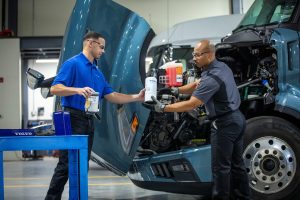
“The trucking industry perennially faces a shortage of technicians which is being compounded now by rapid advances in new powertrain,” said Rick Mihelic, director of Emerging Technologies, NACFE. “The greatest challenge facing all new powertrain technologies is the need for well-trained technicians and well-equipped maintenance shops. The best powertrains are useless if the vehicles cannot be maintained in the field.”
The report covers internal combustion engines, renewable natural gas, battery electric and hydrogen fuel cell vehicles. It explores components such as wheels, tires and brakes as well as delving into the infrastructure needed to service various powertrains. It also looks at the skills technicians are going to need to be able to work on the multiple powertrain solutions that are currently available to fleets in the Messy Middle.
“There is no legacy knowledge that will pour over. That’s the biggest problem,” said Dr. Mark Quarto, CEO Quarto Tech Services. “There’s no way to take a diesel tech and say ‘OK you’ve got the engine, you’ve got the fuel system, you’ve got fuel delivery, you got all these systems’— you can’t. That’s the problem. I’ve worked with many fleets, many college instructors, even engineers, and I can tell you that it takes a long time for them to learn the new stuff. The largest technology competency gaps are in the areas of electrical, electronics, software, power electronics, and electric machines.”
Important findings in the report are:
- Maintenance costs are a significant factor in investing in new trucks. Those costs also often include facility infrastructure maintenance, special equipment and training for technicians, and ongoing auditing and record keeping.
- The key to keeping trucks on the road, high uptime, will continue to depend on the skills of the technicians and the tools available to them. Intelligent OEM service tools and fault-diagnosis systems will be critical to reducing downtime.
- Service of natural gas, hydrogen, battery electric, and bio-fuel systems demand greater attention to safety and equipment protocols than traditional diesels.
- Technician training and keeping that training current will need to be a priority for service managers, including tracking and auditing of skills and certifications. The pace of technology change will require continuous training and recertifications.
- Computers will likely be the first tools needed to diagnose and service vehicles. They will also need to be kept current with appropriate software licensing and regular hardware updating that will need to be factored into costs.
- OEM warranties will become even more critical as the complexity of vehicles increases with new technologies.
- for the foreseeable future, standards and procedures will be rapidly evolving as fleets gain experience and provide feedback to OEMs. Staying aware of changing standards and staying compliant may lead to additional labor costs to factor into investment planning.
- Behind the fence fueling infrastructure maintenance will be as challenging and may be necessary to keeping trucks running. Public infrastructure maintenance or lack thereof may also factor into vehicle uptime.
- Predictive maintenance enhanced by artificial intelligence systems will greatly aid technicians.
- Specialization in new technologies is inevitable for service technicians as the complexity of vehicles continues to grow. This may require additional staffing to cover all the critical new technologies to keep fleets moving.